What Must Legally Appear on a Payslip in South Africa?
Discover what South African employers must legally include on employee payslips under the Basic Conditions of Employment Act (BCEA). Learn about salary details, PAYE, UIF, deductions, overtime and payroll compliance.
By Kiboko Payroll · Published

What Must Legally Appear on a Payslip in South Africa?
A payslip is more than just a document showing how much an employee earns at the end of the month. It is an important employment record that explains how an employee's salary is calculated, what deductions have been made and how much money they actually receive.
For South African employers, issuing payslips is an important part of payroll administration and compliance. Whether you operate a small business with two employees or manage a company with dozens of staff members, understanding what information must appear on a payslip can help you avoid payroll mistakes and maintain accurate employment records.
The Basic Conditions of Employment Act (BCEA), Act 75 of 1997, sets out the information employers must provide to employees when paying their remuneration.
In this guide, we explain what must legally appear on a payslip in South Africa, which additional details are recommended, and how businesses can simplify payroll administration.
1. What Does South African Law Say About Payslips?
Section 33 of the Basic Conditions of Employment Act requires employers covered by this provision to provide employees with written information about their remuneration each time they are paid.
The purpose is to ensure employees understand:
- Who is paying them.
- Which salary period they are being paid for.
- How much they have earned.
- What deductions have been taken from their salary.
- How much they will actually receive.
There are important exemptions. Under section 28(2), the requirements in section 33 do not apply to employers employing fewer than five employees or to the employment of domestic workers. Section 28(1) also excludes employees working fewer than 24 hours per month from this chapter.
Even where an exemption applies, maintaining transparent payroll records and providing clear payment information remains good business practice.
2. Information That Must Appear on a Payslip
For employers covered by section 33, the following information must be provided.
2.1 Employer's Name and Address
Every payslip must identify the employer responsible for paying the employee.
This includes:
- The employer's name.
- The employer's business address.
For example:
| Employer Information | Example |
|---|---|
| Company name | ABC Trading (Pty) Ltd |
| Business address | 25 Main Road, Cape Town, 8001 |
This information helps employees identify the organisation issuing the payslip.
2.2 Employee's Name and Occupation
The payslip must contain the employee's name and occupation.
For example:
| Employee Information | Example |
|---|---|
| Employee name | John Smith |
| Occupation | Administrative Assistant |
This ensures that the payslip is clearly associated with the correct employee.
2.3 Payment Period
The payslip must indicate the period for which the employee is being paid.
For monthly-paid employees, this is normally a calendar month.
For example:
- Pay period: 1 October 2026 – 31 October 2026.
- Payment date: 31 October 2026.
This is particularly important when calculating salaries for employees who joined, resigned or took unpaid leave during a particular month.
2.4 Total Remuneration or Salary
The payslip must show the employee's remuneration in money.
This is commonly displayed as gross salary or total earnings before deductions.
Depending on the employee's remuneration structure, this may include:
- Basic salary.
- Overtime payments.
- Commission.
- Bonuses.
- Taxable allowances.
- Other monetary earnings.
For example:
| Earnings | Amount |
|---|---|
| Basic salary | R20,000.00 |
| Overtime | R1,500.00 |
| Commission | R2,000.00 |
| Total earnings | R23,500.00 |
Employees should be able to understand how their total earnings were calculated.
2.5 Deductions and Their Purpose
One of the most important requirements under section 33 is that employers must disclose the amount and purpose of every deduction made from an employee's remuneration.
Common deductions include:
- PAYE (Pay As You Earn).
- UIF employee contributions.
- Pension or provident fund contributions.
- Medical aid contributions.
- Approved loan repayments.
- Other authorised deductions.
For example:
| Deduction | Amount |
|---|---|
| PAYE | R2,800.00 |
| UIF | R177.12 |
| Medical aid | R1,200.00 |
| Total deductions | R4,177.12 |
Employers must also ensure that deductions are legally permitted.
Under section 34 of the BCEA, deductions generally require written agreement, a legal requirement or another permitted legal basis, such as a collective agreement, court order or arbitration award.
An employer cannot simply deduct money from an employee's salary without a valid legal basis.
2.6 Actual Amount Paid (Net Salary)
The payslip must clearly show the actual amount paid to the employee after deductions.
This is commonly known as:
- Net salary.
- Take-home pay.
- Net pay.
Using the previous example:
| Description | Amount |
|---|---|
| Total earnings | R23,500.00 |
| Total deductions | R4,177.12 |
| Net salary | R19,322.88 |
The employee should be able to see exactly how much they are receiving after all applicable deductions.
2.7 Ordinary Pay Rates and Overtime Rates
Where relevant to the calculation of remuneration, the payslip must show the employee's remuneration rate and overtime rate.
For example:
| Description | Rate |
|---|---|
| Ordinary hourly rate | R120.00 |
| Overtime hourly rate | R180.00 |
This helps employees understand whether their overtime payments have been calculated correctly.
2.8 Ordinary and Overtime Hours Worked
Where relevant, employers must also indicate:
- Number of ordinary hours worked.
- Number of overtime hours worked.
For example:
| Hours Worked | Total |
|---|---|
| Ordinary hours | 176 |
| Overtime hours | 10 |
This is particularly important for businesses that pay employees based on hourly rates or regularly calculate overtime.
2.9 Sunday and Public Holiday Hours
If an employee works on Sundays or public holidays, the number of hours worked on those days must be reflected where relevant to calculating remuneration.
This allows employees to verify that their additional working hours have been correctly considered.
2.10 Averaged Working Hours
Where an averaging agreement has been concluded under section 12 of the BCEA, the payslip must show the total ordinary and overtime hours worked during the averaging period.
This requirement applies where such an arrangement is relevant to the employee's remuneration.
3. What Does a Compliant Payslip Look Like?
Understanding the legal requirements becomes easier when looking at a practical example.
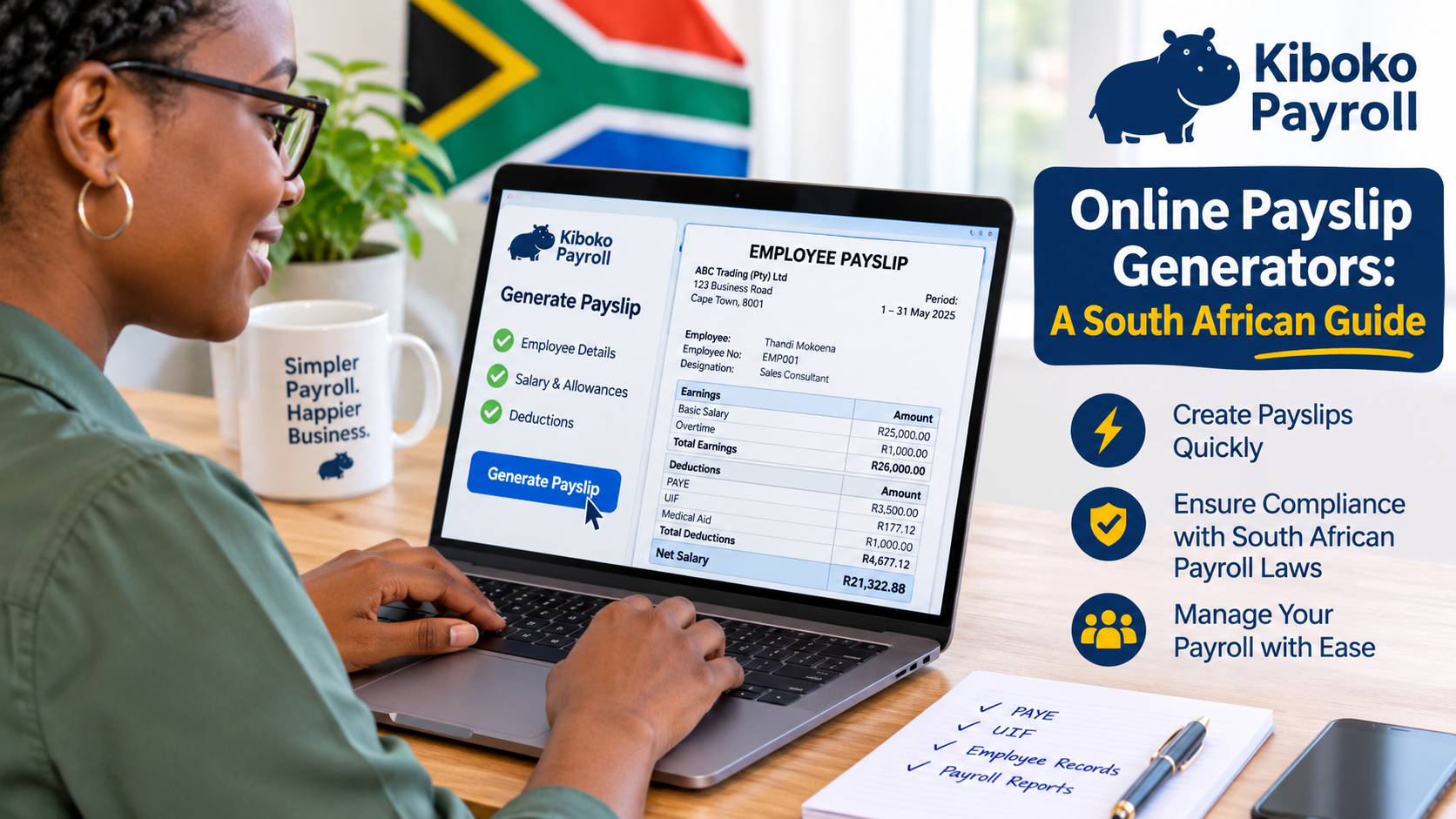
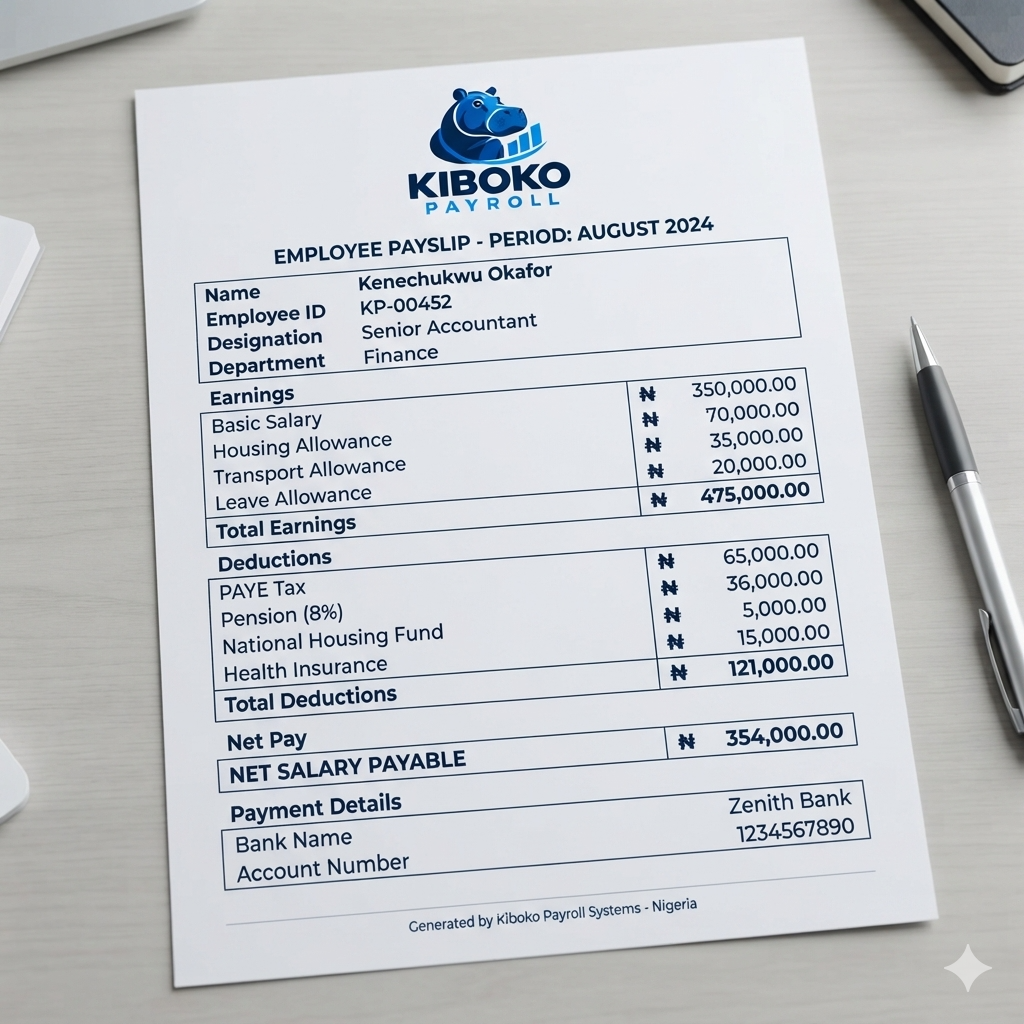
Below is an example of a monthly payslip for a fictional South African employee.
Example Payslip
ABC Trading (Pty) Ltd
25 Main Road, Cape Town, 8001
Employee Details
| Field | Information |
|---|---|
| Employee | John Smith |
| Occupation | Administrative Assistant |
| Pay period | October 2026 |
| Payment date | 31 October 2026 |
Earnings
| Description | Amount |
|---|---|
| Basic salary | R20,000.00 |
| Overtime | R1,500.00 |
| Commission | R2,000.00 |
| Gross earnings | R23,500.00 |
Deductions
| Description | Amount |
|---|---|
| PAYE | R2,800.00 |
| UIF | R177.12 |
| Medical aid | R1,200.00 |
| Total deductions | R4,177.12 |
Net Salary: R19,322.88
Note: This is an illustrative example, not an actual tax calculation. A real payslip should also show applicable ordinary and overtime pay rates and hours, including Sunday and public holiday hours where relevant.
4. What Additional Information Should a Professional Payslip Include?
Although section 33 of the BCEA specifies the minimum information, a professional payroll system should provide additional information to improve transparency and simplify payroll administration.
Here are some recommended fields:
| Additional Information | Why It Is Useful |
|---|---|
| Employee number | Identifies employees internally |
| PAYE reference or tax number | Helps with tax administration |
| ID or passport number | Helps identify the employee |
| Payment method | Shows how salary is paid |
| Bank account details | Helps verify payment information |
| Company logo | Improves document presentation |
| Earnings breakdown | Makes salary calculations easier to understand |
| Leave balances | Helps employees track available leave |
| Year-to-date earnings | Helps employees monitor annual income |
| Employer contributions | Shows additional employer-paid benefits |
These are useful additions, but they should not be confused with the specific mandatory particulars listed in section 33.
Employers should also protect personal information displayed on payslips in accordance with the Protection of Personal Information Act (POPIA).
5. Understanding PAYE, UIF and SDL on a South African Payslip
South African payroll involves several statutory contributions and deductions. It is important to understand which amounts are deducted from employees and which are paid by employers.
PAYE (Pay As You Earn)
PAYE is income tax deducted from an employee's remuneration and paid to the South African Revenue Service (SARS).
The amount depends on the employee's taxable remuneration, applicable tax rates and eligible rebates.
UIF (Unemployment Insurance Fund)
UIF contributions generally consist of:
- 1% employee contribution.
- 1% employer contribution.
The employee contribution is deducted from the employee's remuneration, while the employer contributes an additional amount.
The contribution is subject to the applicable remuneration ceiling.
SDL (Skills Development Levy)
SDL is generally an employer contribution of 1% of the leviable payroll for employers with an annual payroll exceeding R500,000, subject to applicable exemptions.
It is not an ordinary deduction from an employee's salary.
This distinction matters because employers should not incorrectly deduct their own statutory contributions from employee salaries.
| Contribution | Employee Pays | Employer Pays |
|---|---|---|
| PAYE | Yes | No |
| UIF | 1% | 1% |
| SDL | No | Generally 1% if liable |
6. Can an Employer Issue Electronic Payslips?
Yes. Employers can use electronic payroll systems to generate and distribute payslips.
Electronic payslips offer several advantages:
- Employees can access their payslips online.
- Employers can reduce paper administration.
- Payroll documents can be stored digitally.
- Payslips can be generated consistently every month.
- Employees can access previous payslips when needed.
Employers should ensure that employees can access their payslips and that confidential salary information is protected.
An electronic document should still contain all applicable information required by law.
7. What Happens If an Employer Does Not Provide Payslips?
Employers who are subject to section 33 must provide the required written remuneration information when employees are paid.
Failure to comply may result in a labour-law compliance issue.
Employees who believe their employer is not complying with the BCEA can approach the Department of Employment and Labour for assistance.
Employers should therefore make payslip generation a standard part of their monthly payroll process.
8. Common Payslip Mistakes South African Businesses Should Avoid
Even businesses with established payroll processes can make mistakes.
Here are some common problems:
1. Showing Only the Net Salary
A payslip that only displays the amount transferred into an employee's bank account does not provide the required breakdown of remuneration and deductions.
2. Not Explaining Deductions
Displaying a single amount labelled "Other deductions" without explaining its purpose can create confusion and may not satisfy the legal requirement.
3. Incorrect PAYE Calculations
Using outdated tax brackets or incorrect employee information can result in incorrect PAYE deductions.
4. Incorrect UIF Contributions
Employers must calculate both employee and employer UIF contributions correctly, taking the applicable contribution ceiling into account.
5. Forgetting Overtime Payments
Overtime must be calculated using the applicable employment conditions and agreements.
6. Not Updating Employee Information
Changes to salaries, occupations, allowances and other employee details should be reflected accurately in payroll records.
7. Poor Payroll Record Management
Employers should maintain accurate records of remuneration and hours worked. Section 31 of the BCEA generally requires these records to be kept for three years from the date of the last entry.
9. How Payroll Software Helps Businesses Generate Compliant Payslips
Managing payroll manually can become complicated, especially when a business starts employing more people.
Employers must calculate salaries, process deductions, manage overtime, keep employee information updated and generate payslips every pay period.
Using payroll software can make these responsibilities easier.
A good payroll system should help businesses:
- Calculate gross salaries and net salaries.
- Calculate PAYE and UIF deductions.
- Manage SDL employer contributions.
- Record earnings, allowances and deductions.
- Generate professional employee payslips.
- Maintain employee payroll records.
- Access historical payroll information.
- Reduce manual calculation errors.
For small businesses, automating payroll can save valuable administrative time and help maintain more consistent payroll processes.
10. Frequently Asked Questions About Payslips in South Africa
Is an employer legally required to provide a payslip in South Africa?
Yes. Under section 33 of the BCEA, employers covered by this provision must provide employees with written remuneration information each time they are paid. There are specific exemptions, including employers with fewer than five employees and domestic workers.
Must a payslip show PAYE and UIF separately?
Where PAYE and UIF are deducted from an employee's remuneration, they should be identified separately with their respective amounts and purposes.
Must an employer include their company address on a payslip?
Yes. Section 33 requires the employer's name and address to appear on the written remuneration information.
Can an employer deduct money from an employee's salary without permission?
Generally, no. Section 34 of the BCEA regulates deductions. They must have a valid legal basis, such as written agreement, legislation, a collective agreement, court order or arbitration award.
Does a payslip need to show the employee's leave balance?
Leave balances are useful additional information, but they are not among the specific mandatory particulars listed in section 33.
Can I send payslips to employees by email?
Electronic payslips can be used, provided employees receive the required written information and can access it. Employers should also protect confidential employee information.
How long must employers keep payroll records?
Section 31 of the BCEA generally requires employers to keep prescribed employee records for three years from the date of the last entry. Other legislation may impose additional recordkeeping requirements.
Is a company logo legally required on a payslip?
No. A company logo is optional. However, including it can make payslips look more professional and easier to identify.
11. Final Thoughts: Make Payroll Compliance Easier for Your Business
A payslip is an important document that protects both employers and employees by providing a transparent record of remuneration.
South African businesses should understand the requirements of the Basic Conditions of Employment Act and ensure that their payroll processes provide accurate, clear and accessible payment information.
As your business grows, managing salaries, statutory deductions and employee records manually can become increasingly difficult.
The right payroll software can simplify these responsibilities and help you manage your employees with greater confidence.
Simplify Your Business Payroll with Kiboko Payroll
Managing payroll shouldn't take hours of your valuable business time.
With Kiboko Payroll, you can manage employees, process payroll, calculate PAYE and UIF, and generate professional employee payslips from one platform.
Whether you have one employee or a growing team, Kiboko Payroll helps make payroll administration simpler.
- Professional employee payslips.
- PAYE, UIF and SDL calculations.
- Employee and leave management.
- Payroll records and reporting.
- Online employee access.
First Month FREE!
Enjoy a full month of payroll management with unlimited employees during your free trial. No credit card required.
Get Started with Kiboko Payroll
Simple, secure payroll for South African businesses.
Official References
For further information, consult the following official resources:
- Department of Employment and Labour – Basic Guide to Pay Slips
- Department of Employment and Labour – Basic Conditions of Employment Act
- South African Revenue Service (SARS)
Disclaimer: This article provides general payroll information and is not a substitute for professional legal or tax advice. Employers should verify applicable legislation, exemptions and current SARS requirements.