How to Create a Payslip in South Africa
Learn how to create a payslip in South Africa, understand the required salary and deduction details, calculate PAYE and UIF, and simplify payroll with affordable payroll software.
By Kiboko Payroll · Published
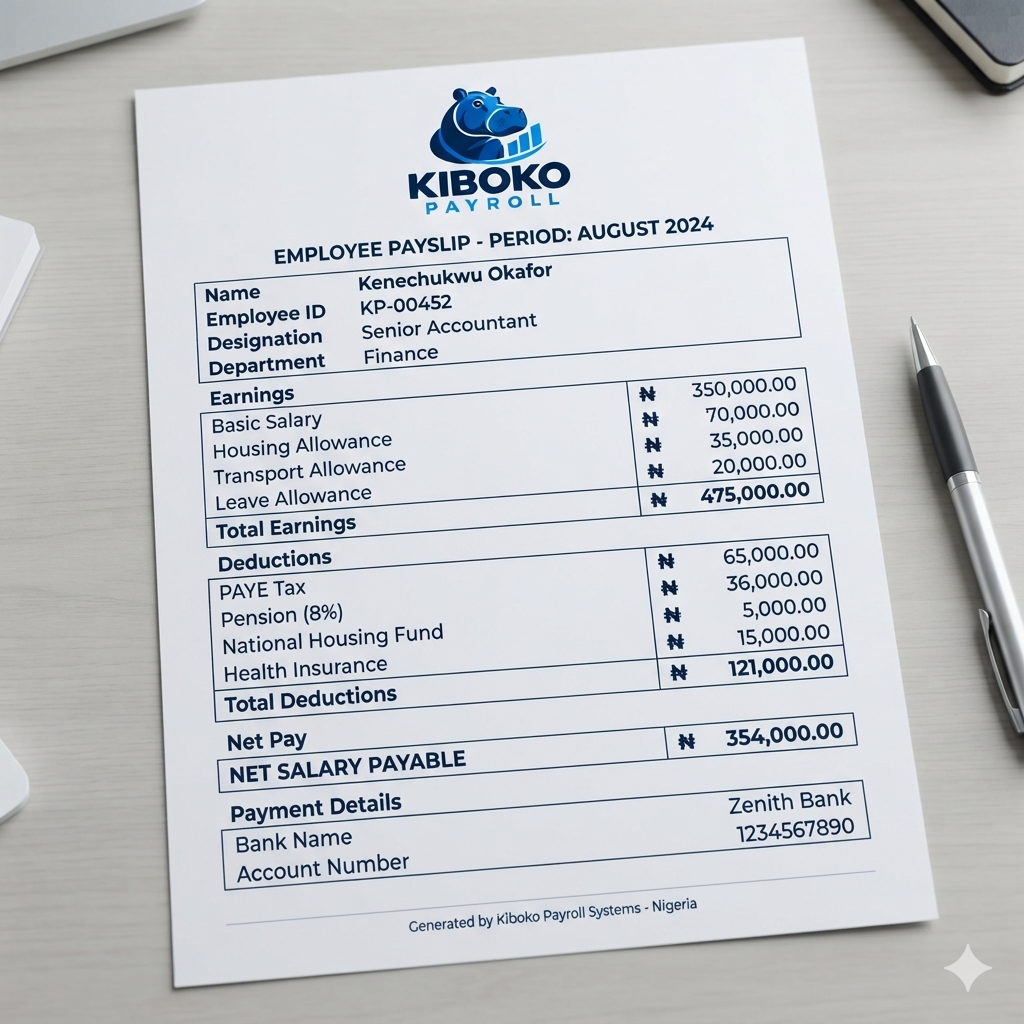
How to Create a Payslip in South Africa: A Complete Guide
Creating payslips is an important part of managing employees in South Africa. Whether you run a small business with one employee or manage a growing team, every pay period requires accurate salary calculations, appropriate deductions and clear records of what each employee earns.
A well-prepared payslip helps employees understand their earnings, deductions and take-home pay. It also helps employers maintain organised payroll records and meet their legal obligations.
In this guide, we'll explain what a South African payslip should contain, how to calculate gross and net salary, how PAYE and UIF work, and how to create payslips more efficiently.
Looking for an easier way to manage employee payslips? Discover Kiboko Payroll, a payroll solution designed for South African businesses. Your first month is free.
What Is a Payslip?
A payslip is a document that records an employee's earnings and deductions for a particular pay period.
It typically shows the employee's salary or wages, any additional earnings, deductions, and the final amount paid to the employee.
For example, an employee earning R20,000 per month may receive a payslip showing their gross salary, PAYE deduction, UIF contribution and net salary.
A payslip provides transparency by helping employees understand how their take-home pay was calculated.
Are Payslips Required in South Africa?
Yes. Under section 33 of the Basic Conditions of Employment Act (BCEA), employers must provide employees with written particulars of remuneration when paying them.
These particulars include information such as the employer's details, employee's details, pay period, remuneration, deductions and relevant hours or rates where applicable.
The exact information required depends on the circumstances and applicable legislation.
Employers should consult the official South African Department of Employment and Labour guidance and the Basic Conditions of Employment Act to ensure their payslips meet the applicable requirements.
What Information Should a South African Payslip Include?
A useful payslip should clearly identify the employer, employee and payment period and explain how the employee's pay was calculated.
Common information includes:
1. Employer Details
Include relevant employer information, such as:
- Business or employer name.
- Employer address or other required identifying information.
- Applicable employer registration details where required.
2. Employee Details
Include the employee's relevant information, such as:
- Full name.
- Employee number, if used.
- Job title or department, where useful.
- Other identifying information required for payroll administration.
Handle personal information securely and only include information necessary for the intended purpose.
3. Pay Period and Payment Date
Clearly state the period covered by the payslip.
For example:
- Pay period: 1 October 2026 to 31 October 2026.
- Payment date: 30 October 2026.
The dates should reflect the actual payroll period and payment arrangement.
4. Gross Salary or Wages
Gross salary is the employee's earnings before deductions.
Depending on the employee's remuneration arrangement, it may include:
- Basic salary.
- Overtime.
- Commission.
- Bonuses.
- Allowances.
- Other taxable or non-taxable remuneration, as applicable.
Each earning component should be recorded correctly and treated according to the applicable tax and employment rules.
5. Deductions
A payslip should clearly show the deductions made from the employee's remuneration.
Common examples include:
- PAYE, where applicable.
- UIF contributions, where applicable.
- Retirement fund contributions.
- Medical scheme contributions.
- Other lawful deductions.
Not every employee will have the same deductions. Employers must ensure that deductions comply with applicable legislation and any relevant agreements or authorisations.
6. Net Salary
Net salary is the amount remaining after the relevant deductions have been taken from gross remuneration.
In a simplified calculation:
Net salary = Gross earnings − Employee deductions
The final amount should match the payroll calculation and payment made to the employee, taking account of the applicable remuneration and deduction arrangements.
How to Calculate a Payslip in South Africa
Let's work through a simplified example for a monthly employee.
Assume an employee earns R20,000 per month and has the following illustrative payroll figures:
| Description | Amount |
|---|---|
| Gross monthly salary | R20,000.00 |
| PAYE | R2,000.00 |
| Employee UIF | R148.72 |
| Total deductions shown | R2,148.72 |
| Illustrative net salary | R17,851.28 |
The PAYE figure above is an illustrative amount, not an official tax calculation for a specific employee. Actual PAYE depends on the applicable tax year, taxable remuneration, rebates, benefits, credits and other circumstances.
The UIF amount is also illustrative. Actual contributions must be calculated using the applicable UIF rules and contribution ceiling for the relevant pay period.
Step 1: Determine Gross Earnings
Start by identifying the employee's earnings for the pay period.
For a salaried employee, this may be their normal monthly salary plus any applicable overtime, bonuses, commission or allowances.
For hourly employees, calculate the applicable ordinary hours and additional earnings according to their employment arrangements and applicable rules.
Step 2: Calculate PAYE
PAYE is the employees' income tax deducted by the employer and paid to SARS.
The calculation depends on the employee's taxable remuneration and the applicable SARS rules.
To understand the tax brackets, rebates and calculation process in more detail, read our guide:
How to Calculate PAYE in South Africa: 2026/2027 Guide
This article explains the progressive tax system and includes a worked annual salary example.
Step 3: Calculate UIF
UIF contributions generally consist of an employee contribution and an employer contribution, subject to applicable rules, exclusions and the remuneration ceiling.
The employee's contribution is normally deducted from their remuneration, while the employer's contribution is an additional employer cost.
Do not assume that the employee's UIF deduction is always 1% of their full salary. Apply the contribution ceiling and the rules applicable to the relevant pay period.
For official information, visit the Department of Employment and Labour.
Step 4: Calculate Other Applicable Deductions
Depending on the employee's circumstances, the payslip may include additional deductions such as retirement contributions, medical scheme contributions or other lawful deductions.
Ensure each deduction is correctly recorded and treated for tax purposes where applicable.
Step 5: Calculate Net Salary
Subtract the employee's applicable deductions from gross earnings.
Using the illustrative figures above:
R20,000.00 − R2,000.00 − R148.72 = R17,851.28.
This is the illustrative net salary for that example only.
Step 6: Generate and Provide the Payslip
Once the calculations have been checked, generate the payslip and provide it to the employee in accordance with applicable requirements.
Keep appropriate payroll records and ensure that payslips are accessible only to authorised individuals.
Common Payslip Mistakes to Avoid
Even a small payroll error can cause confusion for employees and create additional administrative work.
Here are some mistakes employers should avoid.
Using Incorrect Tax Rates
SARS tax tables and thresholds can change. Always use the correct rates for the applicable tax year.
Forgetting Additional Earnings
Overtime, commission, bonuses and allowances may affect gross earnings and taxable remuneration.
Make sure all relevant earnings are recorded correctly.
Confusing Gross Salary With Net Salary
Gross salary is the amount before employee deductions. Net salary is the amount remaining after applicable deductions.
Clearly distinguish the two on the payslip.
Applying UIF Incorrectly
UIF calculations must account for the applicable contribution ceiling and rules. Do not simply apply a percentage to every salary without checking the current requirements.
Failing to Keep Accurate Records
Maintain appropriate payroll records, including earnings, deductions, payment dates and the relevant supporting information.
Sharing Payslips Insecurely
Payslips contain personal and financial information. Use appropriate access controls and secure delivery methods, and follow applicable privacy requirements.
Can You Create Payslips Using Excel?
Yes. A small business can create payslips using a spreadsheet or document template.
However, manual payslip preparation requires careful data entry and consistent calculations.
As your employee count grows, spreadsheets can become harder to maintain. Common challenges include:
- Repeating calculations every month.
- Updating tax rates and thresholds.
- Maintaining employee information.
- Checking deductions.
- Producing individual payslips.
- Correcting errors across multiple spreadsheets.
- Keeping payroll records organised.
If you use Excel, protect sensitive information, verify formulas and review calculations before distributing payslips.
How Payroll Software Makes Payslip Generation Easier
Payroll software can bring employee records, salary calculations and payslip generation into one system.
Depending on the software and its configuration, it can help businesses:
- Maintain employee information.
- Process recurring payroll runs.
- Calculate payroll deductions.
- Generate professional payslips.
- Keep payroll information organised.
- Reduce repetitive manual administration.
The software must still be configured correctly, kept up to date and used in accordance with applicable South African requirements.
Discover Kiboko Payroll
If you're tired of creating payslips manually, Kiboko Payroll offers a convenient way to manage employee information, payroll and payslip generation in one place.
Designed for South African small businesses, Kiboko Payroll aims to make payroll administration more accessible without the high cost and complexity of larger systems.
Why Consider Kiboko Payroll?
- Your first month is free: Explore the platform before choosing a paid plan.
- Affordable pricing: Plans start from R49 per month, subject to the current pricing displayed on the website.
- Employee management: Keep employee information organised.
- Payroll administration: Manage recurring payroll tasks more conveniently.
- Payslip generation: Generate professional payslips for employees.
Whether you have a small team or are preparing for business growth, the right payroll tools can help you spend less time on repetitive administration.
Start Your First Month Free
Ready to simplify payroll and payslip generation for your business?
Visit the official website to explore the platform, features and available plans.
Get started with Kiboko Payroll
Professional payroll. Without the big price tag.
Frequently Asked Questions
Is an employer required to provide payslips in South Africa?
Yes. Section 33 of the Basic Conditions of Employment Act requires employers to provide written particulars of remuneration when paying employees. Employers should check the legislation for the applicable information requirements.
What is the difference between gross salary and net salary?
Gross salary is the employee's earnings before deductions. Net salary is the amount remaining after applicable employee deductions.
Must PAYE appear on every payslip?
PAYE should be shown when it is deducted from the employee's remuneration. Whether PAYE is payable and how much must be deducted depends on the employee's circumstances and applicable SARS rules.
Is UIF deducted from an employee's salary?
The employee's UIF contribution is generally deducted from remuneration, subject to applicable rules and contribution limits. Employers also generally contribute an additional amount.
Can I create payslips for free?
You can create payslips manually using a suitable template, but you must ensure the calculations and required information are correct. Alternatively, you can explore payroll software with a free trial or introductory offer.
Kiboko Payroll offers a free first month. Visit kibokopayroll.co.za to see the current features and terms.
What is the easiest way to generate payslips for multiple employees?
Payroll software can make the process easier by maintaining employee details, managing payroll calculations and generating payslips through a consistent workflow.
Choose a solution that supports your business requirements and applicable South African payroll rules.
Final Thoughts
Creating accurate payslips is an important responsibility for South African employers. A good payslip clearly explains the employee's earnings, deductions and take-home pay while supporting accurate payroll records.
Whether you prepare payslips manually or use payroll software, always verify calculations and follow the applicable employment and tax requirements.
If you want to simplify employee management, payroll administration and payslip generation, explore a solution designed for South African businesses.
Visit Kiboko Payroll and start your first month free.
Professional payroll. Without the big price tag.
Disclaimer: This article is for general educational purposes only and is not legal, tax, accounting or financial advice. Requirements and calculations depend on the applicable legislation and individual circumstances. Consult official government guidance or a qualified professional when necessary.